
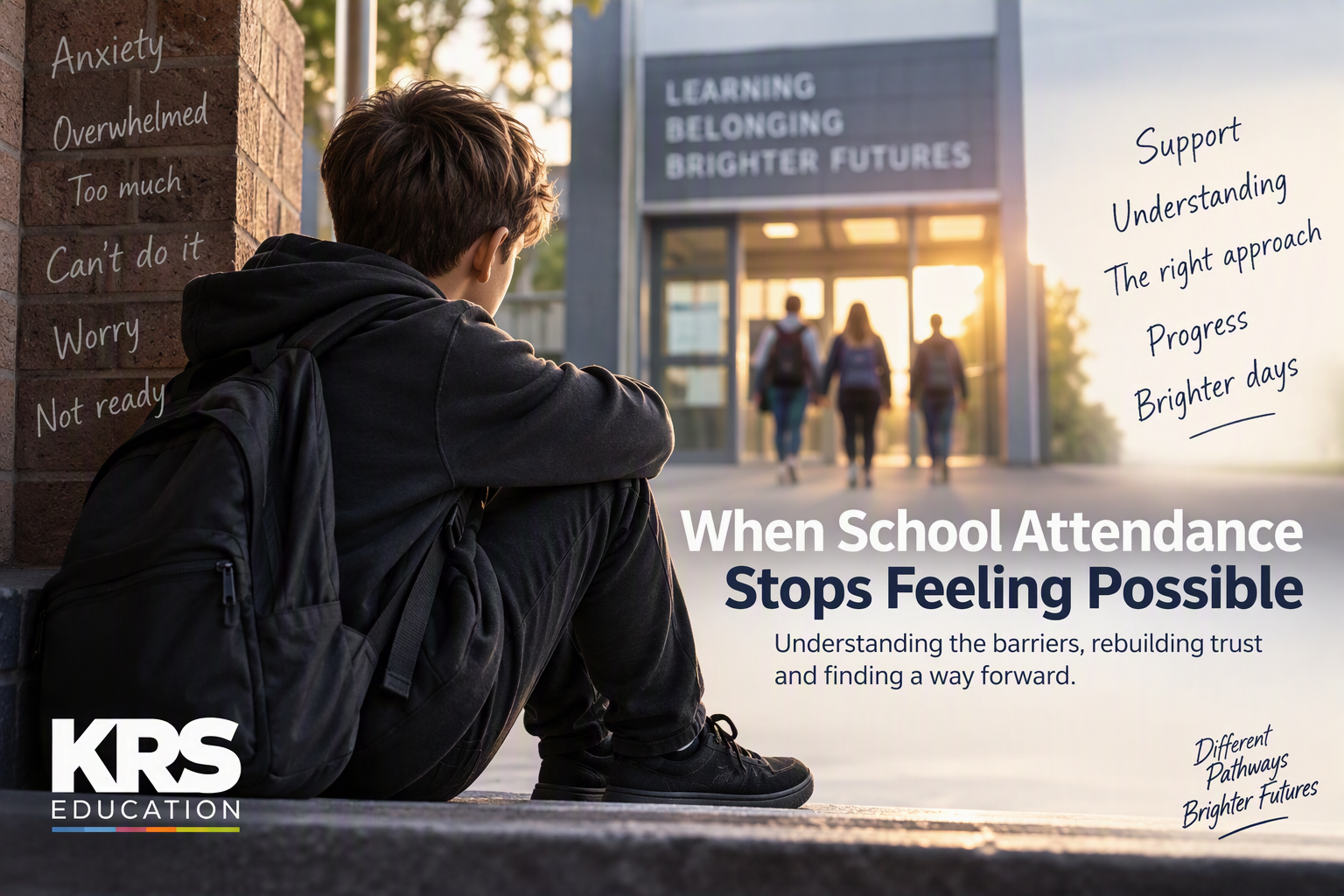
Young person outside a school illustrating school attendance difficulties, EBSA support and alternative provision in Sheffield.

For some young people, getting through the school gates can become one of the hardest parts of their day.

What can begin as the occasional difficult morning can gradually become regular absence, late arrival, anxiety before school or a young person simply saying, “I can’t go.”

For schools and families, this can be incredibly difficult.

There is pressure to improve attendance, keep learning moving and maintain routines. But when a young person is genuinely struggling, simply increasing that pressure doesn’t always solve the problem.

Sometimes we need to stop and ask a different question:

What is making school feel impossible for this young person right now?

When “won’t attend” is actually “can’t attend”

Persistent absence isn’t always about a young person choosing not to engage with education.

There may be anxiety around lessons, difficulties with friendships, bullying, unmet SEND needs, sensory overload, previous negative experiences, difficulties at home or a loss of confidence in learning.

For some young people, these barriers build until attending school feels overwhelming.

This is where EBSA support in Sheffield and early intervention can make a real difference.

Rather than waiting until attendance has completely broken down, schools can look at what is happening earlier and consider what support could help the young person remain connected to education.

That might mean changing part of the school day, introducing additional pastoral support or using alternative provision in Sheffield alongside the existing school placement.

It doesn’t always need to be all or nothing.

Intervene before the placement reaches crisis

This is something we feel strongly about at KRS Education.

Alternative provision shouldn’t only be considered when everything else has failed.

Used properly, it can be an early intervention.

A young person might spend part of their week in a smaller, more supportive environment while remaining connected to their school. For another pupil, support at a particularly difficult point in the day might be enough to prevent things escalating.

The aim isn’t simply to take a young person out of a classroom.

It is to understand the barrier, rebuild engagement and create a realistic route forward.

That’s particularly important when schools are trying to support pupils whose attendance, behaviour, SEND or emotional needs are beginning to affect their ability to cope in a mainstream environment.

SEND support needs to start with the young person

There isn’t one solution that works for every pupil.

Good SEND support in Sheffield needs to recognise that two young people displaying exactly the same behaviour may be struggling for completely different reasons.

That’s why relationships matter.

Smaller groups, consistent adults, practical activities and achievable learning can give a young person the opportunity to experience success again.

We can still have expectations.

We can still encourage attendance, engagement and progress.

But those expectations have to sit alongside an understanding of what is preventing the young person from succeeding in the first place.

Mental health and SEMH cannot be separated from learning

Mental health and SEMH needs can also have a significant impact on how a young person experiences school.

Anxiety, low confidence, emotional distress or difficulty regulating emotions can make concentrating, communicating and even entering a busy learning environment much harder.

That doesn’t mean we lower our aspirations for young people.

It means recognising that, for some pupils, emotional wellbeing and educational engagement need to be supported together.

A young person who feels safe, understood and able to regulate is in a much better position to begin engaging with learning again.

And progress may start small.

Walking through the door.

Completing an activity.

Staying for the whole session.

Building a relationship with an adult.

Trying something they previously avoided.

Those things matter because they can become the foundations for the next step.

Evidence the support, not just the attendance

Schools also need to know whether an intervention is actually helping.

Alternative provision shouldn’t become somewhere a pupil simply goes for a few hours.

There should be purpose behind it.

At KRS Education, we believe schools need clear information about the support a young person is receiving, their engagement and the progress being made.

That evidence helps everyone involved understand what is working, what needs to change and what the next step should be.

Most importantly, it keeps the focus on outcomes for the young person.

There is another step before crisis

If attendance is declining or a pupil is becoming increasingly disengaged, it doesn’t automatically mean their school placement has failed.

But it may mean something needs to change.

The earlier schools, families and support services can work together, the more options there are.

Sometimes the answer isn’t another sanction or another conversation about attendance.

Sometimes it starts with understanding why attending has become so difficult and building the right support around that young person.

At KRS Education, we work with schools and young people in Sheffield to provide practical, targeted alternative provision and support.

If you’re supporting a young person whose attendance, SEND or SEMH needs are becoming increasingly difficult to manage, speak to us before the situation reaches crisis.

Supporting a young person with attendance, SEND, SEMH or engagement difficulties?

If you’re a school, family or professional supporting a young person whose attendance, SEND or SEMH needs are becoming increasingly difficult to manage, speak to us before the situation reaches crisis. We’ll give you an honest, practical conversation about what support could help.